From Podcast to Publishable Shorts
How to Turn a Podcast into Short Clips with ClipPrism
Turn a video podcast into short clips with ClipPrism. Follow a real interview from AI suggestions to a clear, captioned MP4 ready for your final review.
You have the interview, but finding a short excerpt to share takes a few more decisions. An interesting answer still needs enough context for a new viewer, accurate captions, and a clean ending.
This guide shows how to turn a video podcast into a short clip in ClipPrism, from upload to a captioned export. We follow one AI-suggested clip from a ten-minute founder interview. Use the same workflow for your own show or when preparing clips for a client.
The workflow: upload your recording → review suggested clips → choose one useful answer → refine the cut and captions → preview and download.
The result: six suggestions narrowed to one relevant answer, then expanded from about 12 to 24 seconds to include the host’s question. Watch the 24-second result.
1. Give the clip a purpose, then upload
Before choosing a moment, write down who this particular post is for and what they should learn. “Promote the episode” is a distribution goal; it does not yet tell you which answer to select.
Our example uses The Build Log interview with Colin Sidoti. We want to make a post for SaaS founders and product managers deciding which customer feature requests to build. Define a similarly specific viewer and question for your own recording.
Start with a video recording you own or have permission to edit and share. Open My videos, choose a video file or paste a supported video link, select its spoken Video language, and give it a recognizable name. Confirm your content rights and check the file and account limits before choosing Find clips. We started with Automatic recommendations.
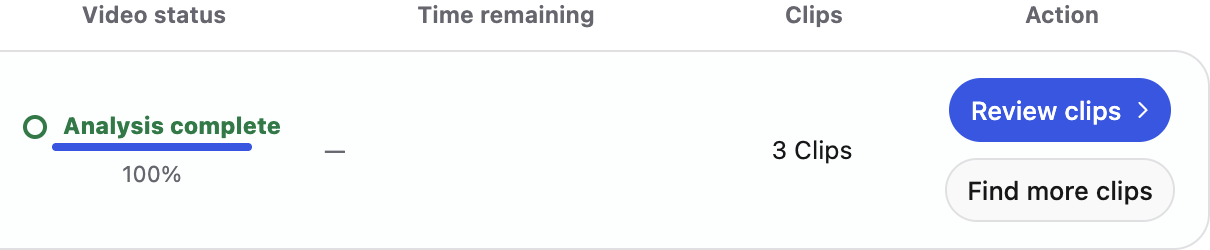
Keep the page open until submission is confirmed. You stay on My videos, where Recent videos shows the processing percentage and estimated time remaining when available. When the status is Analysis complete, choose Review clips. Already have a topic in mind? Read the guide to finding podcast clips by topic.
2. Use AI recommendations as a shortlist
The automatic pass returned six candidates. An IPO-related moment scored 84/100; a product-roadmap moment scored 70/100. We chose the roadmap candidate because it addressed this post’s question.
Read the recommendation reason and any flagged issues, then compare them with the actual excerpt. Does the speaker answer the question you want to explore? Does the selected passage include the context a new viewer needs? A score can help you decide what to inspect first. It is not a forecast of views or a substitute for your brief.
You do not need to resolve every candidate before moving on. Pick one worth editing. The 70-versus-84 comparison in Guide 2 explains that editorial choice in more detail.
3. Adjust the boundaries for understanding
The original roadmap suggestion was about 12 seconds long. It began with the guest’s answer, without the host’s preceding question. In Refine, we moved the start earlier to keep that question and trimmed a little from the end.
The editing view shows an original range of approximately 07:27.7–07:39.6 and a revised selection around 07:15–07:39, in source-video time. The downloaded file is about 24 seconds long.
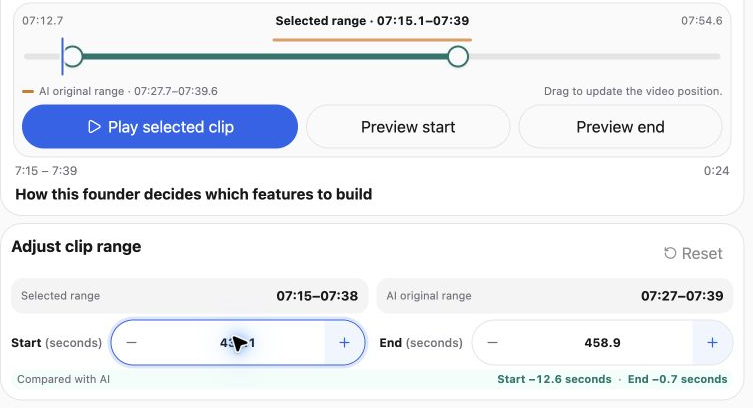
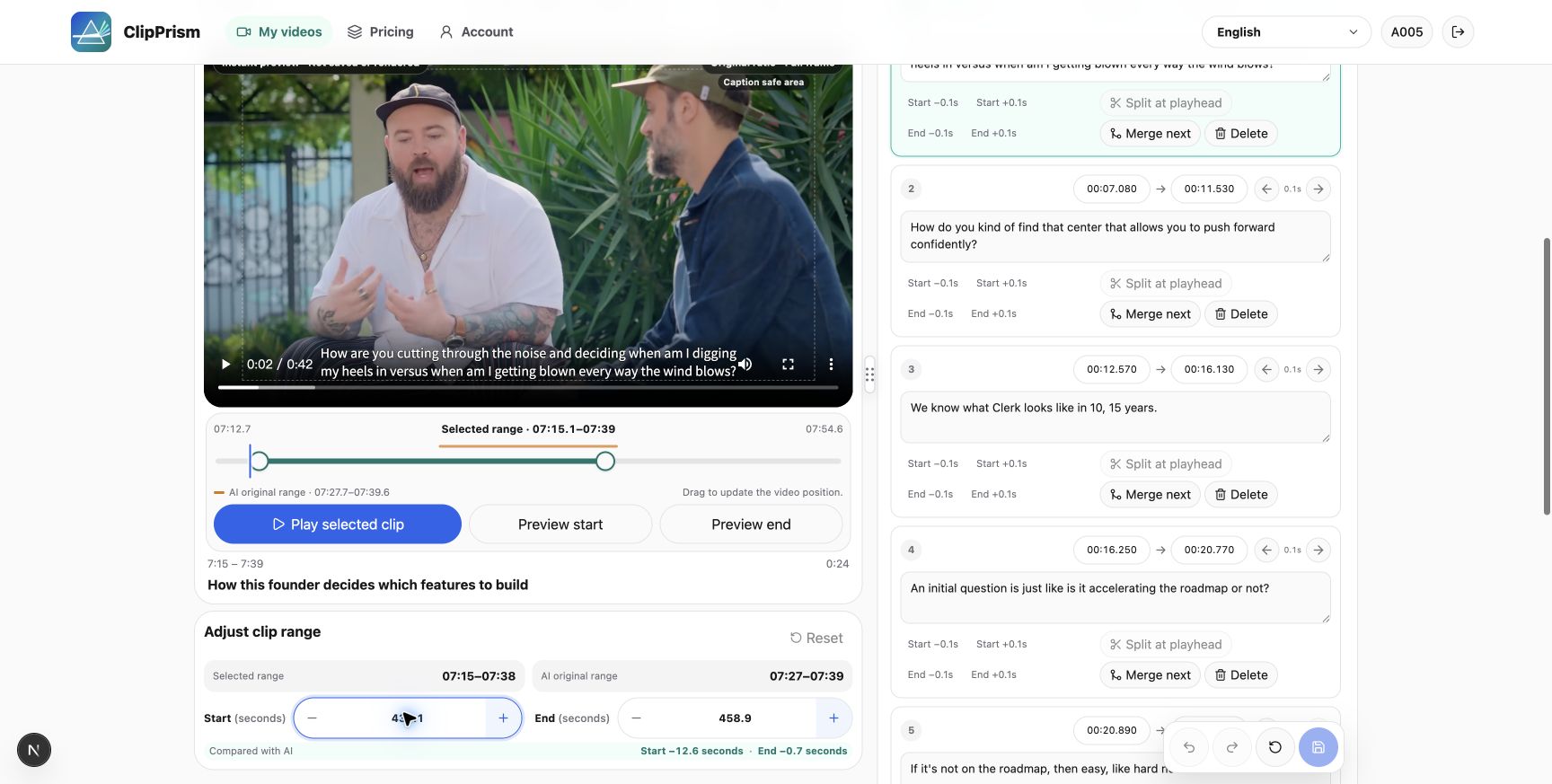
Move the start only as far back as the viewer needs, and stop after a complete thought. Then replay both boundaries. Adding a question may clarify the exchange, but it also takes up time—and the question can still depend on earlier context. In this case, it frames a decision about staying the course; it does not explicitly name customer feature requests. The guide to choosing start and end points shows how to make this tradeoff.
4. Check captions and the saved preview
After changing the range, review the captions for the new selection. Check names, words that change the meaning, and lines that appear too early or linger after the speaker has moved on. We corrected the company name Clerk.
For recurring names and technical spellings, ClipPrism offers Professional terms and Account glossary. Guide 5 explains how to preview term corrections and reuse a glossary, with a review before changes are saved.
Keep the speaker’s words separate from promotional copy. A suggested opening hook can help you write a post title; it should not replace what the person actually says in the subtitles.
Choose Save changes, then Refresh final preview. Check speech with sound on, then check whether captions are readable without sound. Inspect the opening, ending and shot changes. In Finished clip check, address required items and complete your review before choosing Download MP4.
5. Export and inspect the actual MP4
Here is the finished edit: a 24-second captioned MP4 in 16:9 landscape. Play it to hear how the host’s question leads into the guest’s answer.
Read the captions in the reviewed example
Captions from the video, formatted for reading.
Host: How are you cutting through the noise and deciding when am I digging my heels in versus when am I getting blown every way the wind blows? How do you kind of find that center that allows you to push forward confidently?
Guest: We know what Clerk looks like in 10, 15 years. An initial question is just like, is it accelerating the roadmap or not? If it’s not on the roadmap, then easy, like hard no.
Open the downloaded MP4 and confirm its boundaries, captions, sound and framing. This example preserves the source’s landscape composition. For a vertical post, follow the 9:16 interview reframing guide, which compares this edit with a vertical version.
Before posting, add a truthful title and a clear route to the full episode or another relevant next step. For this clip, a title such as A founder’s roadmap test for customer feature requests would identify the subject without promising a universal formula.
What access does this workflow need?
Caption editing and topic search are available with Lite and Standard. Compare plans to choose the features and processing allowance you need.
Start with one interview and one useful answer
Choose an owned or authorized recording and write the question your next viewer needs answered. Open it in ClipPrism, review the suggestions, and develop one candidate before planning a batch.
Turn your podcast into clipsTry one video up to 30 minutes without an account, using an upload or a supported platform link. Review your top three clips, adjust their boundaries, and save notes. Create a free account to export MP4 clips.
Use a recording you own or have permission to edit and share.