
From Podcast to Publishable Shorts
Podcast Clip Checklist: What to Check Before Publishing
Use this podcast clip checklist before you publish. Review context, captions, framing, audio, credits, and the final MP4, then prepare the post.
Your podcast clip is nearly ready to post. Before you share it, take a few minutes to check the opening, captions, framing, and sound in the exported file. This checklist helps you catch the small mistakes that are easy to miss while editing and gives a teammate a clear version to publish.
Check the exact file you intend to post: meaning, boundaries, captions, framing, sound, permission, and packaging. Make any final corrections, export again if needed, and confirm you are posting the updated version.
This checklist is for podcast and interview creators preparing clips from recordings they own or are authorized to share. Copy it into your episode notes and use it for each selected clip.
1. A checklist you can copy into your episode notes
Clip title / version:
Intended viewer and one takeaway:

[ ] Context: a newcomer can identify the question and speaker.
[ ] Meaning: the cut preserves necessary reasons and qualifications.
[ ] Boundaries: the opening and final words sound complete.
[ ] Captions: names, terms, numbers, and negations match the speech.
[ ] Timing: each caption appears with the correct phrase.
[ ] Readability: captions are readable at normal speed on a phone and do not cover essential content.
[ ] Framing: the relevant people and content stay visible throughout.
[ ] Sound: speech is audible; no missing audio or distracting cut.
[ ] Permission: this use and any added media are covered.
[ ] Credits: required attribution and change notes are prepared.
[ ] File: the downloaded MP4 is the version I reviewed.
[ ] Packaging: the title accurately describes what the clip says.
[ ] Next step: the full episode or relevant destination is clear.

Decision: ready / fix / set aside
Specific fix, if any:
Final filename and reviewer:
Mark an item only after checking it. If a teammate handles publishing, record the final filename and the specific version they should use. “The latest one” becomes ambiguous as soon as another export exists.
2. Review what a new viewer will believe
Start without reading your own post description. Can you tell who is speaking, what they are responding to, and what the point is? Read the sentence before and after the source excerpt when checking a strong claim. A missing “in this case” can matter more than a polished opening.
In our roadmap example, restoring the host’s question increased the clip from about 12 seconds to about 24. It improved context, but the answer still gives only one criterion for requests. A title promising the founder’s complete decision framework would go beyond the excerpt.
If the opening needs work, return to the start-and-end guide. Keep a required question or qualification. If the available source cannot make the point fairly, set the candidate aside.
3. Use three focused playback passes
First, listen. Play from the beginning through the end at normal speed. Check whether the first syllable is clipped, one speaker becomes difficult to hear, or the last sentence cuts off. Listen across speaker changes, where differences in recording level can make one person harder to hear.
Then read without sound. Follow the captions at normal speed. Check names, numbers, technical terms, and words that reverse meaning. Look for a line that vanishes too quickly or stays after the next person starts speaking. For recurring names, use Professional terms and Account glossary; Guide 5 explains the correction and glossary workflow.
Finally, watch the picture with sound. Check the first frame, every speaker or camera change, and the ending. Inspect faces, gestures, shared screens, and caption placement. For a vertical version, use the framing guide and review at phone size. Each pass directs your attention to a different part of the viewing experience.
4. Separate editing, rendering, and downloading
In ClipPrism, choose Save changes after your edits. If the saved version needs a new render, choose Refresh final preview. Read Finished clip check, address required items, and complete the review before using Download MP4.
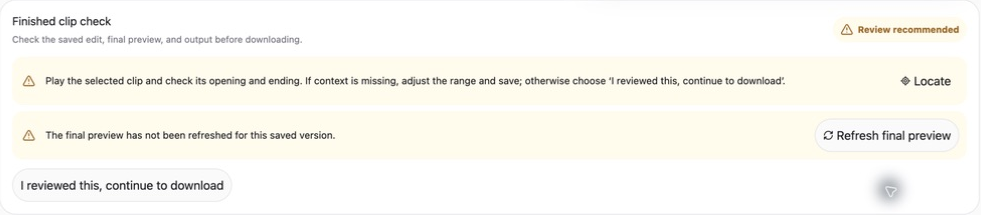
If the changes were saved but rendering failed, use the preview retry action. Once the result plays correctly, download it and open the file in your video player.
Verify the duration and aspect ratio, but also replay the content. Make sure you did not download an older landscape version when you meant to use the new vertical one. Check that the intended caption treatment is present. If you change anything after this pass, repeat the relevant check on the new file.
5. What the checklist catches in the roadmap example
| Check | What this example shows | What to do before posting |
|---|---|---|
| Context | The reviewed cut includes the host’s question. | Still identify the topic and speaker for viewers who do not know the episode. |
| Captions | The company name is corrected to Clerk. | Review all lines, not only the corrected name. |
| Output | The same answer is available as a 16:9 landscape edit and a 9:16 vertical edit, both about 24 seconds. | Choose the intended version. In the vertical comparison, check the host-to-guest transition and the host’s long caption. |
| Claim | The answer explains the roadmap criterion. | Package it as one criterion, not the full framework. |
Compare the two actual cuts if you want to practice the context check. Mark your chosen export ready only after it passes the checklist. Record a concrete fix for any failed item, or set the clip aside if the source cannot support the intended claim.
6. Prepare permission, credits, and the viewer’s next step
Confirm that you can edit and share the source recording and any added music, graphics, or other media. A publicly viewable video is not by itself permission to republish it. Keep the relevant permission or license information with the project, and include the attribution required for your material.
Keep the source title, creator, source link, license information, and relevant edit notes together so they are easy to include wherever attribution is required. The credits below show how we document the example used in this series.
Write a title that the excerpt supports. Add a useful next step, such as the full interview, and check the link. Preview the post in its destination before publishing so you can inspect text placement and the opening presentation. For a podcast teaser, a clear invitation such as “Watch the full conversation with Colin Sidoti” tells viewers what they can explore next.
For several clips from one episode, run the checklist on each one. Different boundaries can introduce different caption and framing problems even when the source and settings are shared.
Get your next podcast clip ready to share
Choose Review clips for your processed recording in Recent videos, then select the candidate you want to publish. Work through this checklist and check the downloaded file after any corrections.
Review your clip in ClipPrismUse a recording you own or have permission to edit and share. Compare plans and available features.